Nobody Planned It. Sixty Thousand People Did It Anyway.
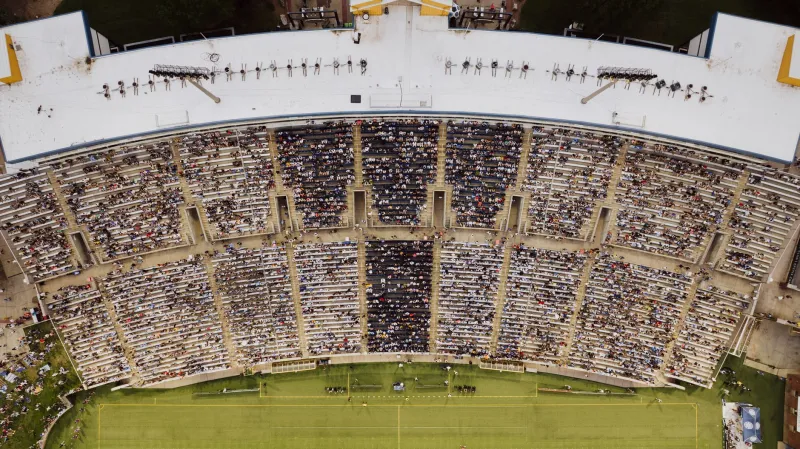
At some point in the last few decades, someone in a stadium stood up, threw their arms in the air, and sat back down — and the person next to them did the same thing, and then the next person, and then the next, until a visible wave of human motion rolled all the way around the stadium like a slow-motion ripple in a very large pond.
The wave. You know it. You've probably done it, maybe enthusiastically, maybe reluctantly, maybe while loudly insisting you weren't going to do it and then doing it anyway because the social pressure in a stadium is genuinely hard to resist. It serves no purpose. It changes nothing about the game. It doesn't help your team, distract the opposition, or communicate anything meaningful to anyone. And yet it's one of the most globally recognized fan behaviors in existence, replicated in stadiums from Pasadena to Prague.
How does something like that start? The answer involves a cheerleader, a football game, and a lot of competing claims — but the real story is less about who invented it and more about why it caught on so fast.
The Most Contested Origin Story in Sports
Ask sports historians where the wave began and you'll get a spirited argument. There are at least three serious contenders, and each one has genuine evidence on its side.
The most widely cited origin points to Robb Weller, a cheerleader at the University of Washington, and his collaborator, a professional cheerleader and entertainment director named "Krazy George" Henderson. In October 1981, at a playoff game between the Oakland A's and the New York Yankees, Henderson — known for his drum-banging, crowd-conducting performances — orchestrated what many consider the first documented wave in a professional sports stadium. Henderson has been vocal about his claim, and there's video evidence that supports his version of events.
But the University of Washington's claim is nearly as strong. Just weeks later, in October 1981, the wave appeared at Husky Stadium during a football game, reportedly organized by Weller. Washington fans adopted it enthusiastically and spread it through college football with remarkable speed. For years, many people assumed the wave was a college football invention precisely because it spread so visibly through that world.
A third claim comes from various international sources suggesting versions of the coordinated crowd motion appeared in soccer stadiums in Latin America and Europe around the same period, possibly independently. The 1986 World Cup in Mexico brought the wave to a global television audience and cemented the Spanish term "la ola" — the wave — as its international name.
Why 1981 and Not 1951?
The timing is interesting. Stadium crowds had existed for a century before the wave appeared. Why didn't it happen sooner?
Part of the answer is scale. The wave requires a large enough crowd that the visual effect actually reads — you need thousands of people for the rolling motion to be visible and satisfying. Older stadiums were often smaller, less uniformly arranged, or had sightlines that made the effect harder to perceive.
But the more compelling explanation is cultural. The early 1980s were a moment when stadium entertainment was actively evolving. Teams were investing in scoreboard prompts, organized chants, and coordinated fan sections. The idea that a crowd could be directed — that sixty thousand strangers could do the same thing at the same time — was becoming part of the stadium experience in a new way. Henderson and Weller didn't invent the concept of crowd coordination. They just found the specific physical form that worked.
Once it existed, it spread with the kind of speed that only happens when something is immediately, intuitively understandable. You don't need to explain the wave to anyone. You see it coming, you know what to do, and you either join it or you don't.
The Psychology of Doing Something Pointless Together
Sports psychologists have spent some time thinking about why the wave persists, and their answers are more interesting than you might expect.
The wave is, at its core, a moment of voluntary synchronization. You're choosing to move your body in coordination with thousands of strangers. That act — even when it's silly, even when it's happening during a blowout in the seventh inning — creates a brief but genuine sense of shared identity. You're not just watching the same game. You're doing something together.
There's also the physical sensation of anticipation. When the wave is coming around the stadium toward you, there's a real moment of preparation — you can see it approaching, you know your section is next, you feel the slight social pressure of participation. That small arc of tension and release is genuinely pleasurable, which is why people who claim they hate the wave usually do it anyway.
The wave also tends to appear when the game itself has gone quiet — during a lopsided score, a long pitching change, or a rain delay. It's what crowds do when they need to remind themselves they're still there, still a collective, still part of something worth showing up for.
A Tradition That Belongs to Nobody and Everyone
What's striking about the wave's origin story is how quickly it became anonymous. Within a few years of 1981, most fans doing the wave had no idea where it came from or who started it. It felt like it had always existed. It felt like something sports crowds had always done.
That's the hallmark of a genuinely successful tradition — it stops needing an origin story to justify itself. The wave doesn't persist because people remember Krazy George Henderson banging his drum at the Oakland Coliseum. It persists because it works. Because it's fun. Because sixty thousand people standing up and sitting down in sequence is, against all logic, one of the more joyful things a crowd can do together.
Somebody started it. Everybody owns it now.