That Spinning Pole Outside Your Barbershop Is a Leftover from When Haircuts Could Kill You
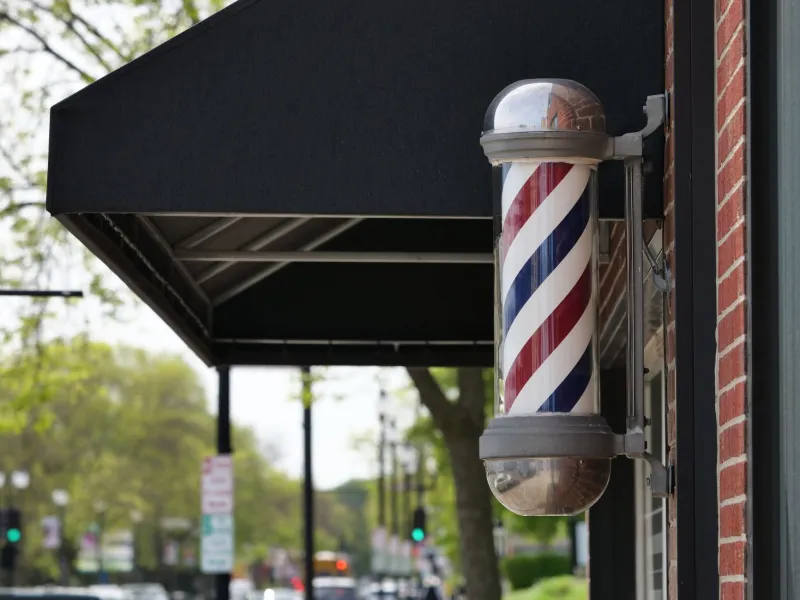
Next time you walk past a barbershop, take a second look at that pole out front. The red and white stripes spinning in a slow, hypnotic loop. You've seen it a thousand times. You probably never thought twice about it.
You should have.
That pole isn't a design choice. It isn't a branding decision some clever marketing team cooked up. It's a medical relic — a direct descendant of a practice so widespread and so gruesome that it defined healthcare in Europe for nearly five hundred years. And somehow, it followed us all the way to the strip malls of the twenty-first century.
When Barbers Ran the Hospital
In medieval Europe, the church had a problem. Monks were the most educated people around, and educated people were the ones doing medicine. But somewhere around the twelfth century, the Catholic Church decided that men of God shouldn't be drawing blood — it was considered undignified, spiritually compromising work.
So they outsourced it.
Barbers were already in the business of handling sharp instruments. They shaved faces, trimmed hair, and kept their tools clean. That made them the obvious candidates to take over the hands-on, bloody side of medical practice. Overnight, the local barber became something closer to a surgeon.
These men — called barber-surgeons — didn't just cut hair. They pulled teeth, lanced infections, amputated limbs on battlefields, and most commonly of all, they bled people. Bloodletting, the practice of deliberately opening a vein to drain what physicians believed was excess or corrupted blood, was the dominant medical treatment of the era. Got a fever? Bloodletting. Feeling sluggish? Bloodletting. Recovering from a wound? Bloodletting. It sounds absurd now, but for centuries it was as routine as taking an aspirin.
The Pole That Advertised the Procedure
Here's where the pole comes in.
When a patient came in for bloodletting, they were handed a wooden staff to grip tightly. Squeezing it made the veins in the arm stand out, which made the incision easier. Afterward, the bandages used to dress the wound were washed and hung outside on that same pole to dry in the open air — because nothing said "open for business" quite like a length of blood-stained linen flapping in the breeze.
As those bandages dried and twisted around the pole in the wind, they formed a spiral pattern. Red from the blood. White from the clean cloth. Over time, barber-surgeons began painting their poles to mimic that pattern permanently, so people could identify their shop from down the street.
The pole wasn't decoration. It was an advertisement. It told you exactly what happened inside.
What the Colors Actually Mean
The version most Americans see today — red, white, and blue — is actually a uniquely American variation that emerged in the nineteenth century. In England, the traditional pole was red and white only. The blue was added in the United States, and historians have offered a few explanations: it may have been a nod to the American flag, or it may have been used to distinguish barbers from surgeons after the two professions formally split.
That split happened in England in 1745, when King George II signed an act separating barbers from surgeons entirely. Surgeons were elevated into their own professional guild. Barbers were officially restricted to haircuts and shaves. The two trades, which had been legally and practically intertwined for centuries, went their separate ways.
The surgeons moved on. The barbers kept the pole.
A Symbol That Outlived Its Meaning
By the time bloodletting fell out of medical favor — largely discredited by the mid-1800s as germ theory and modern medicine began to take hold — the barber's pole had already become so familiar that nobody thought to question it. It had crossed the Atlantic, planted itself in American towns, and quietly detached from its origins.
For most of the twentieth century, the pole was just the pole. A visual shorthand. A way to find a haircut. Nobody hanging around a barbershop in 1955 was thinking about medieval bloodletting.
But the symbol never fully erased its past. Medical historians point to the barber's pole as one of the most enduring examples of what they call a "fossil symbol" — an image that survives long after the practice it represented has disappeared. Like a word whose original meaning has been forgotten, the pole kept spinning.
Still Spinning, Still Mysterious
Today, the barber's pole is making something of a comeback. As classic barbershops have surged in popularity over the last decade — part of a broader cultural nostalgia for old-school grooming rituals — the spinning pole has returned to storefronts across the country. Barbers display it with pride. Customers walk past it without a second thought.
Which is a little funny, when you think about it.
Every one of those poles is, technically speaking, an advertisement for surgery. A remnant from a time when the man trimming your sideburns might also be the man setting your broken arm or draining a wound in a battlefield tent. It's a piece of medical history hiding in plain sight, dressed up in patriotic colors, spinning cheerfully outside shops where the most dangerous thing on offer is a straight razor.
The barber's pole began as a symbol of blood. It stayed as a symbol of craft. And somewhere in that five-hundred-year journey is a reminder that the ordinary things around us are almost never as simple as they look.