The Numbers on the Field Were Nobody's Idea — Until Everyone Needed Them
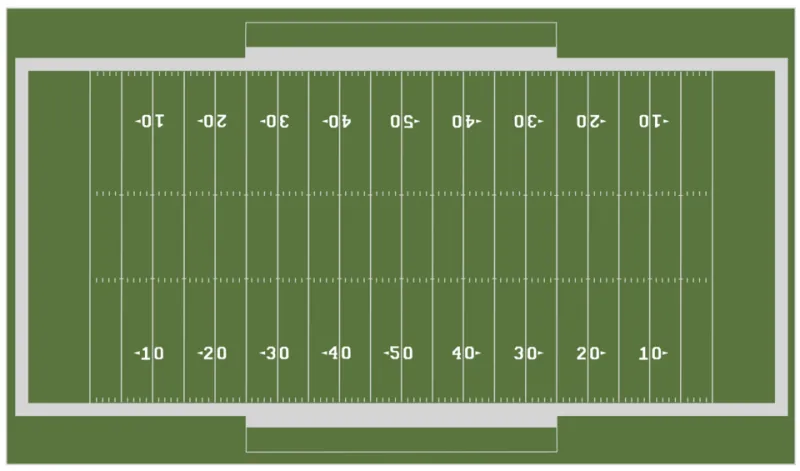
Photo: Wikideas1, CC0, via Wikimedia Commons
The Numbers on the Field Were Nobody's Idea — Until Everyone Needed Them
Look at any football field in America — high school, college, or NFL — and you'll see the same thing: bold white yard-line numbers painted at regular intervals, running from the 10 up to the 50 and back down again. They're so familiar they're practically invisible. Part of the scenery.
But those numbers didn't appear fully formed. They were argued over, ignored, redesigned, and standardized through decades of disagreement between coaches, officials, and league administrators who couldn't agree on something that now seems completely obvious.
The story of how a number got painted on a football field is, like a lot of origin stories, mostly a story about chaos.
A Game Without a Map
Early American football — the version played in the 1870s and 1880s — borrowed its field from rugby and didn't bother much with markings. The field had boundary lines. That was about it. Referees tracked field position by memory and approximation, which worked well enough when the game was slower and the crowds were small.
As football evolved through the 1880s and 1890s, the rules changed dramatically. Walter Camp, the Yale coach widely credited as the father of American football, introduced the line of scrimmage, the down system, and a points structure that made field position genuinely meaningful. Suddenly, knowing exactly where the ball was on the field wasn't just useful — it was essential to understanding the game.
 Photo: Walter Camp, via m.media-amazon.com
The response was the gridiron: a field crossed with parallel lines at five-yard intervals, running the full width of the field. By the early 1900s, most organized football fields had these lines. They gave the game its distinctive grid appearance and its nickname.
But lines alone created a new problem. If you're sitting in the upper rows of a stadium, or reading a newspaper account of a game, parallel lines with no labels are almost useless. Which line is which? How far from the end zone? Nobody could tell.
The Number Question
The push to add numbers to yard lines gained traction in the early 1900s, but agreement on how to number them took surprisingly long to reach.
The core debate was deceptively simple: do you number from each end zone (so the line closest to each end zone is the 5, the next is the 10, and so on up to the 50), or do you use a single continuous numbering system? The first option — which is what we use today — makes intuitive sense to a modern viewer. But at the time, some coaches and officials preferred numbering the lines 1 through 20 from one end to the other, which they argued was cleaner and less confusing.
There were also fights about size. How large should the numbers be? Large enough to read from the upper deck? Small enough not to interfere with the players' footing? Early painted numbers on some fields were modest enough that they were nearly invisible in photographs, which defeated the purpose entirely.
And then there was the question of placement. Should the numbers sit at the edge of the field, where they'd be easy to read from the sideline seats? Or in the middle of the field, where they'd be visible from both sides of the stadium? Different schools adopted different approaches, and for decades, walking into an unfamiliar stadium meant relearning the visual language of the field.
College Football Leads, the NFL Follows
College football was the dominant version of the game through the first half of the twentieth century, and it was college conferences that first pushed for standardized field markings. The Big Ten and other major conferences began enforcing consistent numbering requirements for member schools in the 1920s and 1930s, motivated partly by the growth of radio broadcasts.
 Photo: Big Ten, via content.sportslogos.net
That last part matters more than it might seem. Radio announcers describing a game to listeners who couldn't see it needed precise field position references. "Near the 35-yard line" was useful. "Somewhere in their own territory" was not. As radio coverage of college and professional football expanded through the 1930s, the pressure for clear, consistent field markings increased accordingly.
The NFL, which had been operating since 1920 but was still finding its footing as a business through much of that decade, gradually aligned its field standards with what college football had established. By the late 1930s and into the 1940s, the numbered yard-line format that fans recognize today was becoming the consistent standard across both levels of the game.
Television finished the job. When NFL games began appearing on television in the late 1940s and the league's TV deals expanded through the 1950s, the need for instantly readable field markings became non-negotiable. A viewer watching a small black-and-white screen needed those numbers to understand what they were seeing. The field had to be legible.
The Officials Nobody Remembers
No single person invented the yard-line number system. It emerged from a slow accumulation of practical decisions made by conference administrators, rules committee members, and groundskeeping crews who were just trying to solve an immediate problem.
The forgotten officials who sat on college football rules committees in the 1920s and 1930s — the people who debated font size and placement at meetings that generated no headlines — are the ones who actually locked in what every football field looks like today. Their names aren't in any Hall of Fame. Their decisions are invisible precisely because they worked.
What the Numbers Actually Gave the Game
It's worth pausing on what standardized field markings actually changed about football as a cultural experience.
Before clear numbering, football was a sport you had to already understand to follow. Field position was opaque to casual observers. The drama of a long drive — the grinding, yard-by-yard progress toward the end zone — wasn't visible to someone watching from a distance.
Numbered yard lines made that drama legible. A team on their own 15, driving toward the opponent's end zone, tells a story that anyone can read at a glance. The tension of a fourth-and-one at the opposing 35 is immediately comprehensible. The field became a visual narrative tool.
That's not a small thing. It's part of why football became America's most-watched sport — the game is designed, right down to the paint on the grass, to be understood quickly and followed intuitively.
Somebody had to figure that out. It just took them longer than you'd think.