There's a Reason Every Park in America Has That One Weird Corner
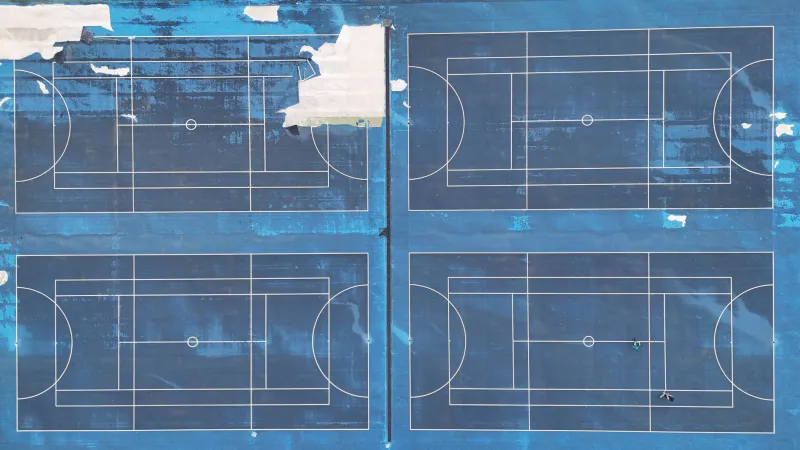
Go to any public park in the United States this weekend and look closely at the grass. You'll find a mess: football yard lines painted over soccer penalty boxes, a lacrosse circle overlapping a rugby pitch, maybe some cricket markings nobody remembers making. American multipurpose fields are a palimpsest of every sport that ever needed forty yards of flat grass.
But amid the chaos, one thing stays constant. And once you notice it, you'll see it at every diamond in the country.
Why the Lines Collide in the First Place
The jumbled field isn't laziness — it's math. Land is expensive, and a full-size soccer pitch needs roughly 70 by 110 yards. A football field needs 100 yards plus end zones. Building separate facilities for each would double or triple a parks department's budget, so American towns pioneered the multipurpose field: one rectangle, striped for whoever's in season.
The trick is that the sports rotate. Soccer owns the fall and spring. Football takes over in late summer. Lacrosse and rugby squeeze in where they can. The lines coexist because the seasons mostly do — the field is never actually hosting two sports at once, just the ghosts of all of them at once.
It's a deeply American solution. In much of Europe or South America, a field means one thing: soccer, forever. In the US, where kids are expected to sample three sports a year and high schools can't afford dedicated stadiums, shared grass became the default. The overlapping paint is a map of a culture that refuses to pick just one game.
The One Corner That Never Moves
Now for the constant. Look at the baseball diamond in the corner of that same park. Notice which way home plate faces — toward the southwest, more or less, with the batter looking east or northeast.
This isn't tradition or superstition. It's the sun.
Major League Baseball's rulebook doesn't mandate a direction, but the official guidelines recommend home plate face east-northeast, and virtually every park in America — from Fenway to your town's rec league field — follows it. The reason is simple: baseball is played in the late afternoon and evening, when the sun sinks toward the western sky. If the batter faced west, every pop fly would sail directly into a blinding sunset. If the batter looks northeast, the setting sun falls behind the catcher and the outfielders, where it belongs.
The convention dates to the sport's earliest professional days in the 19th century, when games were scheduled for afternoons because that's when people were free — before electric lights, the sun set the schedule in every sense. Builders oriented diamonds to keep the low sun out of hitters' eyes, and the practice hardened into near-universal design. Even the quirky old stadiums that break other rules almost never break this one. Fenway Park, wedged into a Boston city block since 1912, still angles home plate toward the northeast.
So the next time you're lost in an unfamiliar town, that diamond in the park can function as a compass. Home plate points roughly northeast. The sunset lands in left field. It's the most reliable piece of wayfinding infrastructure in America, and nobody put up a sign for it.
What the Mess Is Really Telling You
There's something fitting about the combination. The chaotic, over-marked rectangle represents what American sports culture is — improvised, shared, endlessly negotiated between seasons and budgets. The diamond in the corner represents what it can't change — a 150-year-old accommodation to a star that still rises and sets on schedule no matter what league is in town.
One corner of the park obeys the sun. The rest obeys the school calendar. Together they tell you more about how this country plays than any single stadium ever could — a landscape written, repainted, and rewritten, with one line drawn long ago and never crossed.