A Nervous Art Director Had 45 Minutes and No Brief — He Drew a Circle and Changed Everything
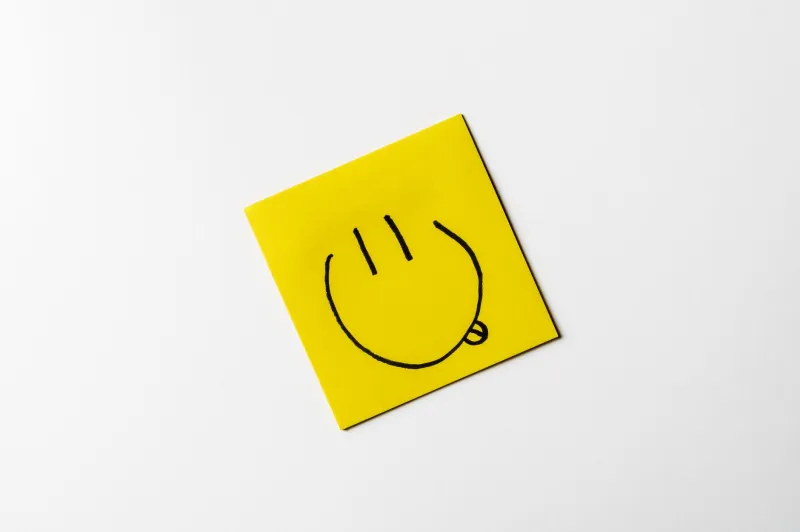
You sent one today. Maybe several. That small yellow circle with the two dots and the curved line. You probably didn't think about it for more than a fraction of a second — just reached for it automatically, the way you reach for punctuation.
The smiley face is so embedded in daily communication that it barely feels like a symbol anymore. It feels like a reflex.
Which makes its origin story all the more disorienting. Because the most universally recognized image on the planet was created in about forty-five minutes, for a company that no longer exists, by a man who made forty-five dollars off the whole thing.
The Merger Nobody Was Happy About
In 1963, a Worcester, Massachusetts insurance company called State Mutual Life Assurance had just completed a merger with Guarantee Mutual Company of Ohio. Mergers, then as now, were bad for morale. Employees were anxious about layoffs. Productivity was slipping. The corporate culture of two companies that didn't particularly like each other had been jammed together under one roof, and the tension was visible.
Management decided they needed a morale campaign. Something internal — buttons, posters, desk cards — to remind employees to smile, stay positive, and act like everything was fine. Standard corporate cheerleading, in other words.
They called a local commercial artist in Worcester named Harvey Ball.
Ball ran a small graphic design firm. He wasn't famous. He wasn't especially sought after. He was available, affordable, and competent, which was exactly what the insurance company needed. They explained the project, gave him almost no specific direction, and asked him to create a simple, cheerful image for the campaign materials.
He reportedly finished the design in ten minutes.
The Design Itself
Ball's process was about as unglamorous as it gets. He drew a circle. He filled it yellow. He added two oval eyes. He drew a curve at the bottom for a mouth. He looked at it, decided the eyes needed to be slightly uneven to keep the face from looking too stiff, and adjusted them.
That was it.
The image cost State Mutual forty-five dollars. They printed it on buttons, which became an immediate hit inside the company. Employees wore them. The mood, by most accounts, actually did improve — at least temporarily. The campaign was considered a success.
And then, crucially, nobody thought to trademark it.
Ball didn't copyright the design. The insurance company didn't either. The smiley face was released into the world with no legal protection, no owner, and no plan.
From Corporate Button to Cultural Phenomenon
For nearly a decade, the image circulated quietly. It appeared on novelty items, greeting cards, and promotional materials — mostly without attribution, mostly without anyone knowing where it had come from. Then, in the early 1970s, two brothers in Philadelphia named Bernard and Murray Spain turned the smiley face into a commercial empire.
The Spains added the phrase "Have a Happy Day" to the image, began manufacturing it on an industrial scale, and sold tens of millions of buttons, bumper stickers, T-shirts, and mugs across the country. The timing was perfect. America in 1971 was deep in Vietnam, Watergate was approaching, and a generation of young people was hungry for any symbol of uncomplicated optimism. The smiley face gave them one.
It became the visual signature of the counterculture — which was deeply ironic, given that it had been created to make insurance company employees feel better about a merger.
The Spains made millions. Harvey Ball made nothing.
The Trademark Wars
Because nobody had secured legal rights to the image in 1963, the smiley face became a perpetual battleground for intellectual property lawyers.
The most aggressive claimant was a French journalist named Franklin Loufrani, who registered the image as a trademark in France in 1971 and spent the following decades building an international licensing empire around it. His company, Smiley Company, eventually held trademarks in more than a hundred countries.
In the United States, Walmart and the Smiley Company spent years in a legal dispute over the image's use in advertising. The case wound through the courts for nearly a decade before being settled in 2011. Harvey Ball, who had died in 2001, was barely mentioned in the proceedings.
Ball himself never seemed particularly bitter about the money. He was fond of pointing out that his creation had made more people smile than almost anything else in history, which he considered a reasonable return on forty-five minutes of work. He did, however, eventually found World Smile Day — celebrated on the first Friday of October each year — partly to reclaim some connection to the image he'd made.
The Emoji and the Circle That Started It All
When Japanese engineer Shigetaka Kurita designed the first emoji set for NTT DoCoMo in 1999, the yellow smiley face was the obvious foundation. The digital version was a direct descendant of Ball's 1963 sketch, translated into pixels and sent rocketing across the internet.
Today, the face emoji and its hundreds of variants are sent billions of times a day across every messaging platform on earth. The Unicode Consortium formally standardized it. Apple, Google, and Samsung each render it slightly differently, but the underlying geometry — yellow circle, two eyes, curved mouth — is always the same.
It is, by almost any measure, the single most transmitted image in human history.
All of it traces back to a ten-minute sketch in Worcester, Massachusetts, commissioned by an insurance company that wanted its employees to stop looking so miserable.
Harvey Ball got forty-five dollars.
The rest of us got a new language.