The Referee Didn't Want to Blow It. He Wanted to Stop a Riot.
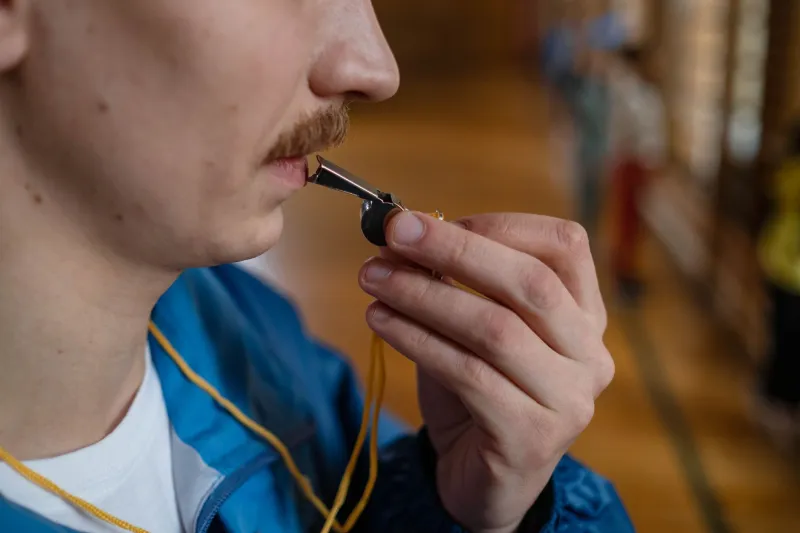
Picture the most powerful sound in sports. Not a crowd roaring. Not a stadium horn. It's the tiny, sharp shriek of a referee's whistle — a sound that can freeze seventy thousand people mid-cheer and send a multimillion-dollar athlete to the bench.
It almost didn't exist. For the first decades of organized soccer, nobody blew anything.
The Handkerchief Era
When the Football Association codified its rules in England in 1863, matches were governed by two umpires who mostly stayed quiet. When a foul happened, the officials waved — a handkerchief, a hat, whatever was handy. Players who looked away missed the call entirely. The system worked about as well as you'd expect.
The real problem wasn't the players, though. It was everyone else.
A Crowd Gets Dangerous
The man who changed all this was Bryan Wall, a former player turned referee who officiated in the Nottingham area in the early 1890s. During a match, Wall made a call that the home crowd did not appreciate. Fans spilled onto the pitch, and suddenly the referee — an ordinary man with a handkerchief and no protection — was facing a hostile mob with no way to summon help.
He survived the incident, but he couldn't shake it. If a referee couldn't make himself heard in a crisis, the handkerchief wasn't just inefficient. It was dangerous.
Wall's solution came from the street. London's Metropolitan Police had recently adopted a whistle to replace the wooden rattles officers once carried — the rattle was loud, but it could be snatched and broken, and it was useless in a scuffle. The whistle was compact, piercing, and always ready. Wall, whose day job was working with police cadets, knew exactly what that little brass tube could do.
In 1878, he became one of the first referees in history to officiate a match by whistle instead of handkerchief. The experiment spread slowly at first — some records credit earlier isolated uses — but by the 1890s, the whistle was standard equipment across British football, and the International Football Association Board wrote it into the laws of the game.
The Pea That Changed the Sound
The early referee's whistle had a flaw: one short blast, then silence. The air channel would fill with saliva and the whistle would choke — famously called "cupping the pea," because of what happened next.
In 1884, Joseph Hudson, a Birmingham toolmaker with a side business making instruments, was experimenting with whistle designs. Legend has it he dropped his prototype and heard something unexpected: the cracked whistle produced a rolling, warbling sound instead of a single note. The crack had disrupted the airflow in a way that created a rapidly oscillating pitch.
Hudson refined the accident into a design. He placed a small ball — a pea, made of cork — inside the whistle's chamber. As air rushed through, the pea bounced around, breaking the airflow hundreds of times per second and producing that unmistakable trill. He called it the Thunderer, and when London's police adopted it, the sound of a Hudson whistle meant one thing: stop.
Referees took it too. The pea whistle could be blown harder, longer, and louder than anything before it, and its two-tone trill cut through crowd noise in a way a straight blast never could. Hudson's company, J. Hudson & Co., still makes whistles in Birmingham today, and versions of his 1884 design are blown at every level of soccer, from youth leagues in Ohio to the World Cup final.
Why the Sound Stuck
There's a reason the whistle outlived every alternative. Human beings are wired to respond to sharp, sudden noises — it's the same reflex that makes a smoke alarm impossible to ignore. A shout can be argued with. A wave of a handkerchief can be missed. A whistle blast triggers something involuntary.
That's what makes it the perfect symbol of authority. The referee doesn't ask for attention; the whistle takes it. In a sport played across every continent, in a hundred languages, the one sound that means exactly the same thing everywhere is that trilling shriek — a direct descendant of a Birmingham workshop accident and a frightened referee who just needed the crowd to hear him.
Next time a match stops on a single note, remember: that sound exists because, more than a century ago, a man with nothing but a handkerchief nearly lost control of a stadium — and decided never to let it happen again.