Dressed by the Gold Rush: How a Tent Salesman's Leftover Fabric Became America's Workwear Bible
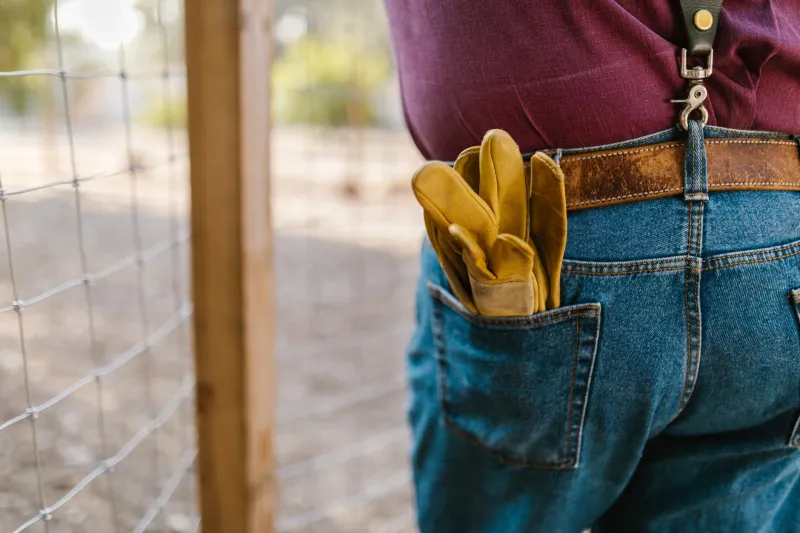
You've probably pulled on a pair of jeans this week without giving it a second thought. Maybe you wore them to a job site, or a coffee shop, or a meeting where the dress code was loosely described as "smart casual." Either way, you were wearing something that started as a desperate fix for a very specific problem: pants that couldn't survive a gold mine.
The story of how denim became the default fabric of American work — and eventually American life — is one of those origin stories hiding in plain sight, stitched into something you've owned since you were a kid.
The Man With a Warehouse Full of Canvas
In 1853, a Bavarian immigrant named Levi Strauss arrived in San Francisco with a head for business and a practical problem. He'd come west with a supply of canvas, intending to sell it for wagon covers and tents. The Gold Rush was still pulling thousands of men into the Sierra Nevada foothills, and Strauss figured there was money in outfitting them.
What he discovered pretty quickly was that the miners didn't need tents half as badly as they needed pants. Specifically, pants that could survive the brutal, crouching, crawling, rock-dragging reality of placer mining. The trousers available at the time — typically made from wool or light cotton — shredded within weeks. Pockets tore off. Seams gave out. Men were essentially destroying their clothing faster than they could replace it.
Strauss pivoted. He started making pants from his leftover canvas. They were ugly, stiff, and had all the elegance of a burlap sack — but they lasted. Word spread fast in the camps, and suddenly Strauss had a product that miners actually wanted.
The Tailor Who Changed Everything
A few years later, a Nevada tailor named Jacob Davis came to Strauss with an idea. Davis had been making the canvas pants for a local customer — a large man whose trousers kept failing at the pocket corners, the point of maximum stress. Davis's fix was almost comically simple: he hammered small copper rivets into the stress points. The pockets held. The seams held. The pants held together in ways no workwear had managed before.
Davis knew he was onto something, but he didn't have the money to patent it. So he wrote to Strauss and proposed a partnership. In 1873, the two men received U.S. Patent No. 139,121 for "an Improvement in Fastening Pocket-Openings." It was, on paper, one of the least glamorous patents in American history. In practice, it was the blueprint for modern workwear.
Around the same time, Strauss swapped the canvas for a French cotton twill — serge de Nîmes — that was softer, more flexible, and even more durable. Americans shortened the name. They called it denim.
The Prison Pipeline Nobody Talks About
Here's the part of the story that rarely makes it into the brand mythology. By the late 1800s and early 1900s, denim work pants had found a significant secondary market: prisons.
State penitentiaries across the American South and West adopted denim uniforms for incarcerated populations almost immediately. The reasons were purely practical — the fabric was cheap, it held up under hard labor, and it was easy to produce in bulk. Prison farms and chain gangs became one of the most consistent buyers of denim workwear for decades.
The irony is striking. A fabric that would eventually become synonymous with freedom, rebellion, and the open road spent a long chapter of its history as the uniform of confinement. The same qualities that made it ideal for a miner — toughness, low cost, resistance to wear — made it equally useful for institutions that needed to clothe large numbers of people who had no say in the matter.
This dual identity quietly shaped denim's cultural journey. It was simultaneously the fabric of the free-ranging frontier worker and the constrained, institutionalized laborer. Both images seeped into the American consciousness.
From the Field to the Factory to the World
By the early twentieth century, denim had migrated from mines and farms into factories. As industrial manufacturing boomed across the Midwest and Northeast, denim overalls and work pants became standard issue for assembly line workers, railroad crews, and construction gangs. Companies like OshKosh B'Gosh built entire businesses around the demand.
Then World War II reshuffled everything. With fabric rationing in effect, denim was officially classified as essential workwear, meaning it could still be produced while other textiles were restricted. American soldiers abroad encountered the pants through USO shows and supply depots. European civilians saw GIs in denim and absorbed it as part of the broader mythology of American cool.
When those soldiers came home, they kept wearing the pants — not to work, but on weekends. That shift was seismic. For the first time, denim was being worn by choice rather than necessity.
Why It Still Matters
The arc from gold mine to global fashion staple is one of the more unlikely journeys in American material culture. Levi Strauss wasn't trying to define how a nation dressed. He was trying to move inventory.
But every time a construction worker pulls on a pair of Carhartt double-knees, every time a tech founder shows up to a pitch meeting in raw denim, every time a kid gets their first pair of Wranglers — they're participating in a lineage that runs straight back to a canvas tent salesman standing in San Francisco, watching miners destroy their trousers.
The most ordinary things in your closet almost always began somewhere extraordinary. This one began at the bottom of a California riverbed, held together by a copper rivet and a good idea.