The Dropout Who Drew America's Game
Every Friday night across America, high school players sprint across perfectly measured 100-yard fields, their cleats hitting yard lines spaced exactly five yards apart. College stadiums stretch the same dimensions from coast to coast. NFL teams battle on identical gridirons whether they're in Green Bay or Miami. But before 1882, football fields looked like whatever patch of grass a school could find.
The man who changed that wasn't a celebrated architect or sports visionary. Walter Camp was a Yale dropout who couldn't pass his engineering courses but had an unusual talent for arguing about rules.
When Football Fields Were Just Fields
In the 1870s, American football was barely recognizable. Teams played on unmarked rectangles of varying sizes, borrowed from local cricket grounds or hastily mowed pastures. Some fields stretched 140 yards, others barely reached 80. Goal lines existed wherever someone stuck a flag in the dirt. The chaos was intentional—early football borrowed heavily from rugby, where irregular playing surfaces were part of the challenge.
But as the sport grew beyond informal college matches, the randomness became a problem. Teams traveling to away games never knew what kind of field awaited them. Spectators couldn't follow the action when yard markers changed from game to game. Newspaper reporters struggled to describe plays when no two fields matched.
Walter Camp saw an opportunity in the mess.
The Failed Engineer's Obsession
Camp had been forced to leave Yale's engineering program after repeatedly failing his mathematics courses, but he possessed something more valuable than academic credentials: an obsessive attention to detail and zero tolerance for inefficiency. While serving on various college football rule committees, he became fixated on standardization.
His first breakthrough came during heated 1880 committee meetings about field dimensions. Rugby purists wanted to maintain the sport's chaotic traditions, while Camp argued for precision. He spent months sketching field layouts, measuring existing playing surfaces, and calculating optimal dimensions for both player safety and spectator visibility.
Camp's engineering failures actually helped him. Unlike trained architects who might have overthought the design, he approached the problem with simple logic: make every field identical so the game itself could be the variable, not the playing surface.
The Blueprint That Built a Sport
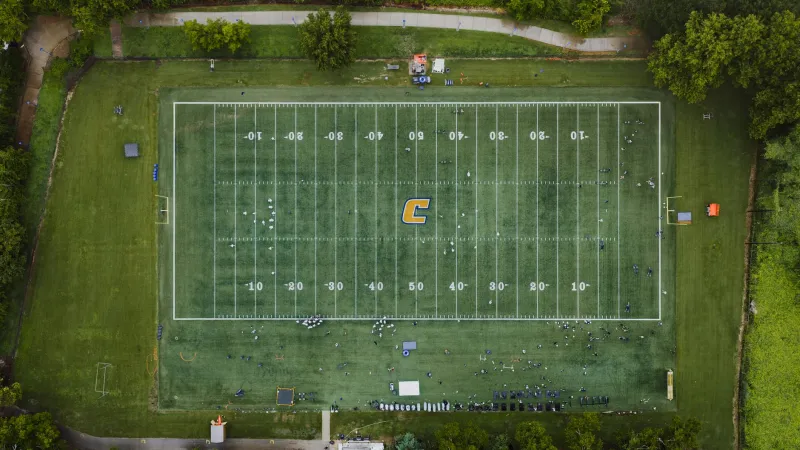
By 1882, Camp had convinced enough committee members to adopt his standardized specifications: 120 yards total length (including end zones), 53⅓ yards wide, with yard lines marked every five yards. The dimensions weren't arbitrary—Camp had calculated sight lines from typical grandstand seating and determined the optimal space for emerging football strategies.
The yard line system was Camp's masterstroke. Unlike rugby's unmarked fields, his grid created a visual reference that transformed football from a chaotic scrum into a strategic chess match. Coaches could diagram plays with precision. Fans could track progress down the field. The "gridiron" nickname emerged naturally from the field's resemblance to a cooking grate.
Resistance was fierce. Established programs complained about the cost of remarking their fields. Rugby traditionalists argued that standardization would ruin football's unpredictable character. Some schools threatened to quit playing rather than conform to Camp's specifications.
From Controversy to Convention
Camp's persistence paid off when influential Eastern colleges began adopting his field design. The visual clarity immediately improved game attendance—spectators could actually follow the action. Newspapers found it easier to report on games when every field shared the same reference points. Within a decade, Camp's standardized field had become the unofficial national standard.
The design proved so effective that it survived every major rule change in football's evolution. When the forward pass was legalized in 1906, Camp's field dimensions accommodated the new strategy perfectly. The NFL adopted his specifications wholesale when it formed in 1920. Even modern innovations like artificial turf and domed stadiums maintain Camp's original proportions.
The Accidental Legacy
Today, Walter Camp is remembered as the "Father of American Football," but his most lasting contribution wasn't any single rule—it was creating the standardized stage where the sport could flourish. His field design enabled football to become a truly national game, with fans in Texas instantly recognizing the same field layout they'd see in Michigan.
Camp never returned to finish his engineering degree, but his dropout project became one of the most replicated designs in American sports history. Every high school, college, and professional football field in the country follows specifications drawn up by a failed math student who simply couldn't stand inefficiency.
The next time you watch a football game, remember that the perfectly measured field beneath the players exists because one man couldn't pass calculus but refused to accept chaos. Sometimes the most important blueprints come from the most unlikely architects.